


 Deutsch
 Français
 العربية
Closure of the allée des Marronniers
Update - 17 March 2026
Half-level opening of the allée des Marronniers
The allée des Marronniers is once again open to half-lane traffic in the downhill direction.
The first stage of the works involved rebuilding the collapsed section, making it safer and enabling traffic to flow again.
A second series of works will complete the project. Dates will be announced shortly.
Update - 4 March 2026
First stage of work on the Chestnut Tree Lane completed
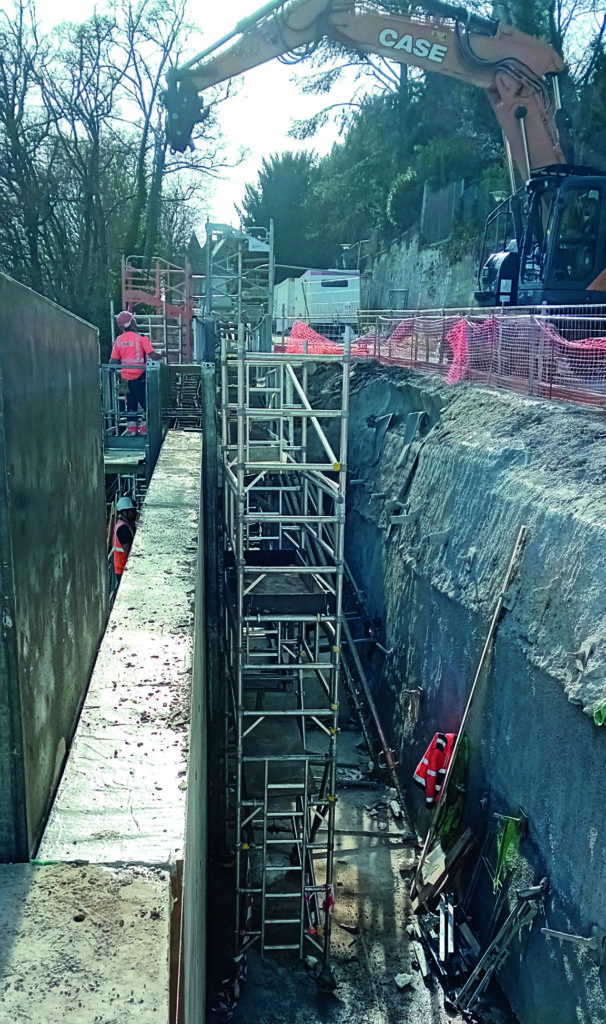
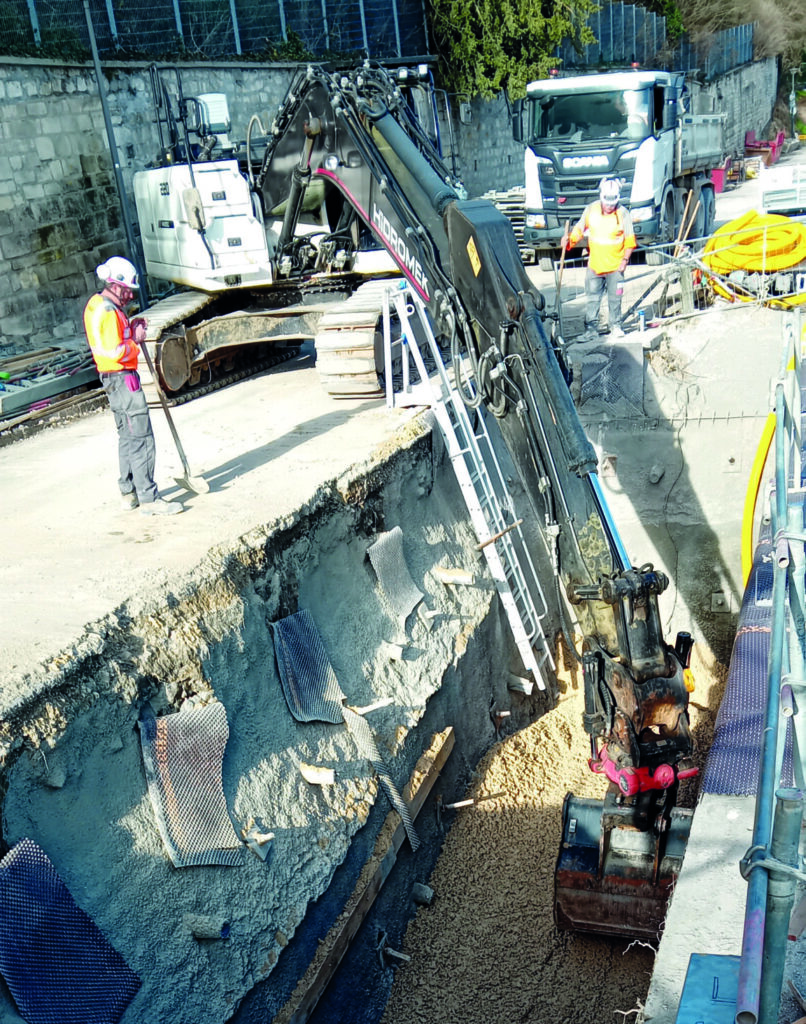
The first stage of the work on the allée des Marronniers is nearing completion. It involved rebuilding two sections of collapsed wall and reinforcing the hillside wall (petit château) at the point of the largest collapse.
During work on the wall, cavities were discovered several metres behind the structure, calling into question the wall's consolidation calculations. New investigations were carried out to determine the volume of the cavities, which have now been filled in.
The very high walls and the presence of a drinking water pipe belonging to ACSO meant that armoured excavations had to be used to avoid destabilising the entire pathway. The retaining walls of both sections were then rebuilt.
For the first section of the works, form removal is underway, followed by backfilling, which has already been completed for the second section. The next stage will be to build the pavement structure, install the barriers and crash barriers, repair the pavements and finally clean up the site.
The progress of the works and the announcement of the resumption of traffic, initially on the dual carriageway and in one direction, will be monitored on the town's website or networks.
Update - February 2026
Information on the complexity of the work on the avenue des marronniers.
In the context of the dispute with the previous companies that had carried out the work, the court's expert opinion required the premises to be kept intact, with no possibility of carrying out the work.
After the expert appraisal, they began in December 2025.
The works involve rebuilding two sections of collapsed wall and reinforcing the hillside wall (petit château) in line with the largest collapse (photo 1).
When the wall on the «petit château» side was reinforced, cavities were discovered several metres behind the structure, calling into question the wall's consolidation calculations. New investigations were carried out to determine the volume of the cavities and to consider the possibility of filling them.
During this period, the contractor and the project management team reorganised the tasks to limit the impact on the duration of the works.
The very great height of the walls and the presence of a drinking water pipe belonging to ACSO (serving several towns) meant that armoured excavations had to be carried out to avoid destabilising the entire pathway. This phase has been completed on the first collapse, and construction of the new wall can now begin (photo 2).
The cavities are currently being filled in, and work has just begun on shoring up the embankment of the second section.
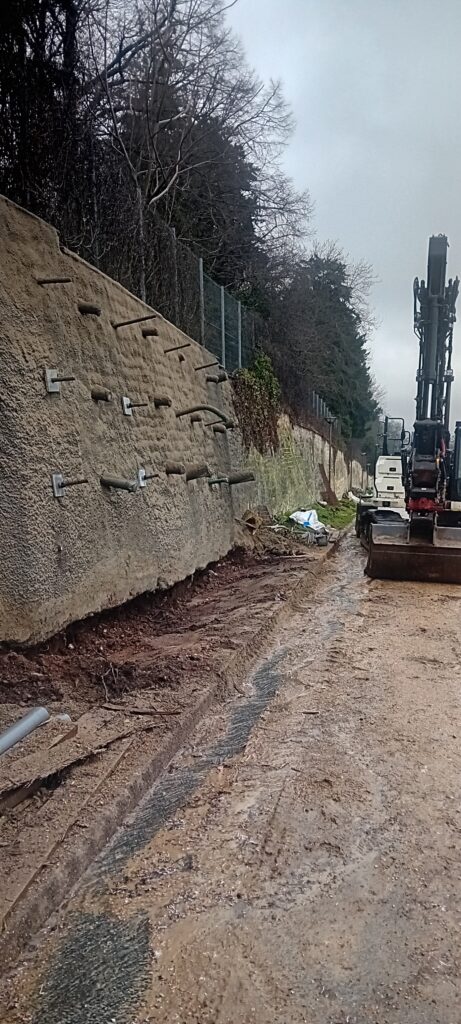
Photo 1
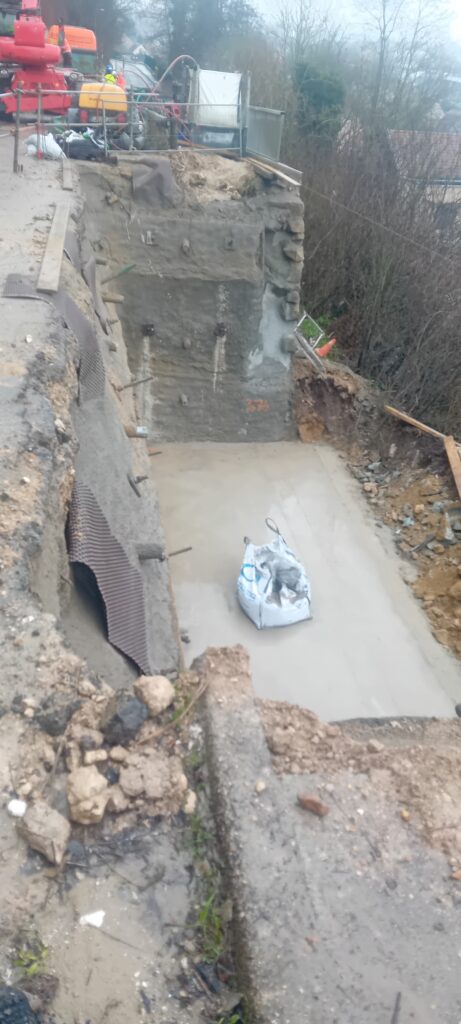
Photo 2
Update - July 2025
3 questions to the Mayor about the allée des Marronniers
Where do we stand technically, and why do the procedures seem to be taking so long?
Indeed, and I deeply regret this state of affairs, since the collapse of a retaining wall and the threats to the pavement in the allée des Marronniers last February, we have been required to carry out a number of studies.
It's obviously not our departments that are at fault, but as we can see in this case as in others, no one wants to take responsibility any more, and studies have to be carried out on the soil, materials, altimetry... to confirm the previous studies.
Of course, you have to protect yourself against any problems that might arise, but at some point you have to stop studying and start repairing.
In concrete terms, today...
The firm commissioned to draw up a schedule of works to be carried out has produced an initial report, which it will have to revisit, since the order from the municipality is very specific: work is due to start at the end of September or the beginning of October at the latest, so that the Chestnut Tree Lane can be reopened by the end of 2025, even if only as a half carriageway (in one direction only).
How do you manage this claim financially?
It should be remembered that the town, on the basis of a study carried out by a consultancy firm, carried out work on the retaining walls in 2022-2023 at a cost of €800,000, and that it was in or near this area that there was a landslide, also linked to bad weather.
We're working on challenging both our insurance and the firm that advised us, but obviously if we wait for the outcome of these actions, the avenue des marronniers will reopen in 4, 5 or 6 years' time. At its meeting on 26 May, the Town Council therefore decided on an initial budget of €500,000 (part of which will go towards the compulsory studies!) and we will then add to the "bill", which is likely to reach €800,000. Fortunately, the town has very little debt.
What temporary solutions can be found to improve traffic flow?
In truth, the topography of our town, with the hillside and the Thérain valley, leaves us with few, if any, options. Whether going downhill or uphill, the allée des marronniers is a strategic route.
Some residents have told us about the "lateral path" between AKZO NOBEL and the railway line from Montataire station, which would link up with the departmental road. Of course we've thought about it, but on the one hand we don't own the road, and it would cost hundreds of thousands of euros to repair it. Together with the ACSO (Greater Montataire area), we're planning to do this as part of the re-industrialisation of the Marinoni/Goss site, but as you can see, it will take a few more years.
I understand the impact that the extra time spent in traffic jams can have on everyone's daily lives. We're always running. For some of us, the pace is already unbearable with our tightly organised schedules. But I want you to know that we are doing everything we can to get the Allée des Marronniers back into operation, within the means at our disposal and above all with the certainty that the safety of everyone - motorists, pedestrians and local residents - is guaranteed. I hope that it will be reopened by the end of the year.
Update - May 2025
Legal expertise and recommendations
A expert appointed by the Amiens Administrative Court confirmed that the driveway was dangerous. He asked that she remains closed to cars and pedestriansand a in-depth geotechnical study (mission G5) be carried out to understand the causes of the collapse.
Safety measures in place
In parallel with the study, the municipal services have taken a number of safety measures:
- Creation of earth embankment to stabilise the wall,
- Installation of sandbags to limit run-off in vulnerable areas,
- Monitoring neighbouring structures and installation of control markers.
The companies in charge of the networks (water, electricity, etc.) have also inspected their facilities in the sector concerned.
Geotechnical study in progress
The company Ginger CEBTP was commissioned to carry out the mission G5. At the end of March and beginning of April core drilling and ground pressure tests were carried out, to a depth of more than 20 metres. The wall and its foundations were also examined.
The soil samples were sent to the laboratory. An initial report is expected before the end of April.
What's next?
- A consultation is underway to appoint a consultancy firm to design the future repair work.
- From traffic adjustments have been made to limit slowdowns, in particular extending traffic light times on Avenue de la Libération.
Since 30 January 2025, the Allée des Marronniers, a major thoroughfare in our town used daily by many of our residents, has been closed to car and pedestrian traffic. This decision, taken by the local council, follows the partial collapse of the retaining walls of the lane, which had been weakened by the bad weather in January.
Despite work, structure weakened by weather conditions
The retaining walls of the allée des Marronniers, made of ashlar and masonry, support the carriageway at a height of
two to five metres above the plots and homes on Rue de Nogent.
Between 2019 and 2024, the City invested more than €900,000 to reinforce these structures. However, the bad weather in January 2025, which caused serious damage to the
episodes of frost followed by heavy rain have made the walls even more fragile, leading to their gradual collapse.
A succession of collapses
The first landslide occurred on the night of 14 to 15 January, above 3, rue de Nogent. The local authority immediately introduced alternating traffic and banned access to the adjacent gardens. The municipal technical services paid particular attention to the fallen wall, taking daily measurements.
But on 30 January, a further section of the walls collapsed, forcing the town to completely close the allée des Marronniers. A barricade and ballast system was put in place to prevent any access.


Expert appraisal underway to assess the risks
On 31 January, the Mayor appealed to the Amiens Administrative Court to warn of the dangers to public safety posed by these landslides. A court-appointed expert visited the site on 4 February and submitted his report on 12 February. His recommendations are clear:
- road closure maintained ;
- no access to gardens and backyards along the retaining wall.
Time-consuming and costly refurbishment
The town now needs to embark on a major refurbishment project. The first stage involves commissioning a geotechnical engineering firm to carry out an in-depth soil analysis. Once these studies have been completed, the Town will be able to start work on consolidating the damaged walls and restoring the plots of land damaged by the landslides.
The work promises to be complex and could take several months to complete. The City is doing everything in its power to ensure the safety of local residents and to restore this vital traffic artery as quickly as possible.
Diversions routes
Direction Avenue Anatole France > Rue de Nogent
Avenue Anatole France > Rue Romain Rolland > Rue Armand Desnosse > Rue de la République
> Rue André Ginisti > Avenue Guy Moquet > Rue de Condé > Avenue de la Libération > Rue Lénine
> Rue Louis Blanc > Rue Henri Vielliard > Rue de Nogent
Direction Rue de Nogent > Avenue Anatole France
Rue de Nogent > Rue Abel Lancelot > Rue Jean Jaurès > Rue du Jeu d'arc > Avenue Anatole France